If there’s one situation that no woman (and many men) feels comfortable going through, it’s hair loss. How many times have we women looked at that clump of hair and wondered whether we’ve already gone beyond the famous 50–100 hairs a day?
Anesthesia is often the first thing to get the blame when hair loss happens after surgery. It’s very common to hear during the pre-anesthetic assessment:
“Is my hair going to fall out after anesthesia?”
Or that sad comment:
“My hair fell out so much after my spinal anesthesia.”
But is that actually true, or is it just another one of those anesthesia myths?
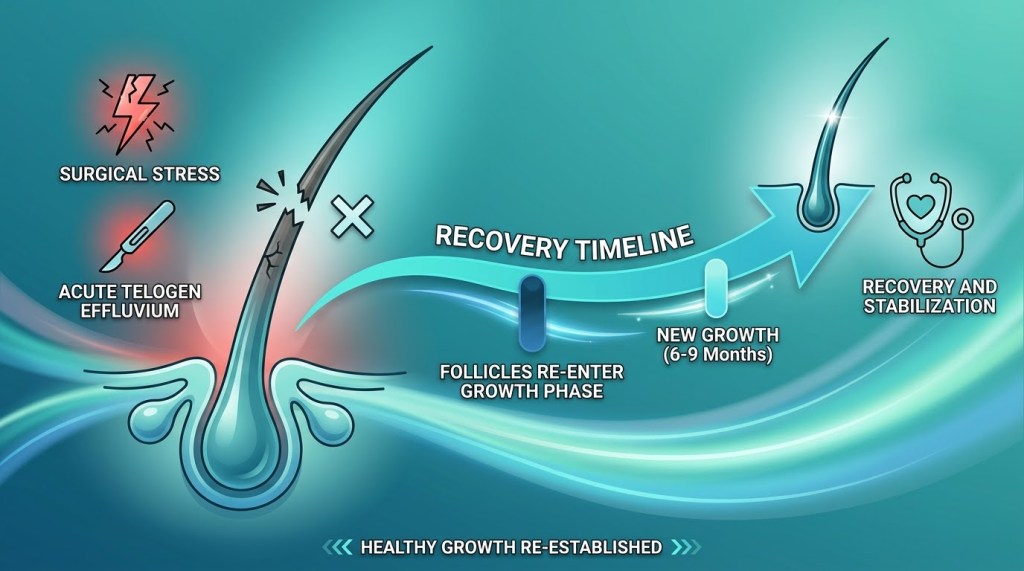
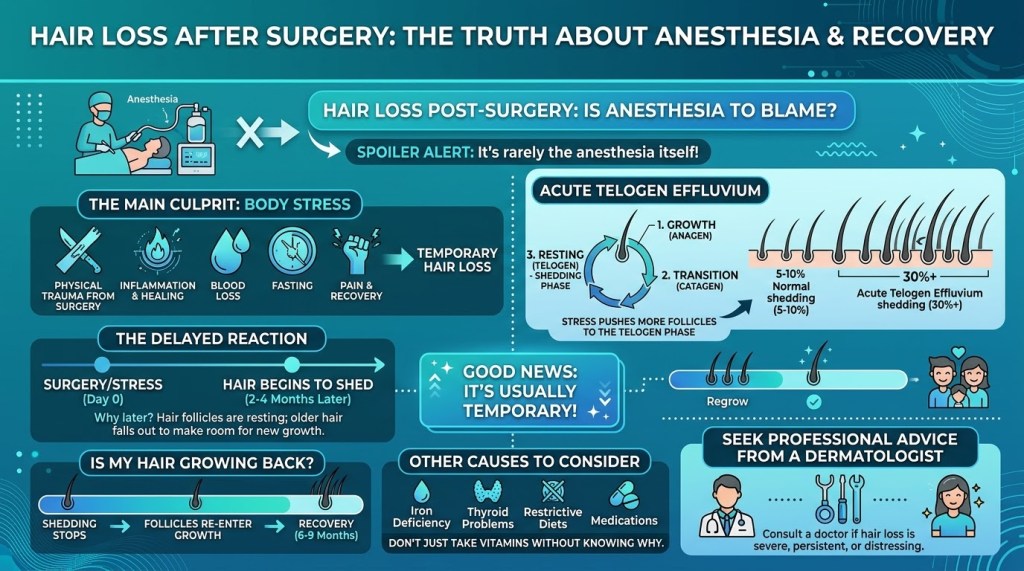
Actually, the hair loss that can happen after surgery has a name: acute telogen effluvium. The name sounds complicated, but the idea is actually pretty simple.
And, first of all, some good news: it’s usually temporary.
In other words, your hair can indeed start falling out after surgery, but that doesn’t mean the anesthetic “killed” your hair or that spinal anesthesia is to blame.
The most likely culprit is the stress your body went through during the entire surgical process.
And here we need to remember that surgery isn’t exactly a walk in the park. There’s the procedure itself, inflammation, possible changes in body temperature, blood loss in some cases, fasting, pain, recovery, infection, or other complications… Your whole body goes into recovery mode.
It’s almost as if your body has a huge priority list after a trauma:
Let’s heal, control the inflammation, keep the blood pressure stable, get everything back in order… the hair can wait a little.
Unfortunately, it really does wait.
That’s why we can also see hair loss after situations that don’t involve anesthesia at all. A classic example is the postpartum period: many women notice significant hair loss a few months after giving birth.
But how does your hair know that your body has been under stress?
Each strand of hair is going through its own little cycle.
Some hairs are growing, others are in a transition phase, and others are in a “resting” phase, until eventually they are shed to make room for a new hair.
Normally, these hairs don’t all fall out at the same time — thankfully! If they did, we would have much more interesting days at the hair salon.
The problem happens when a significant stressor causes many hair follicles to enter this resting phase at roughly the same time.
And here’s one interesting thing about telogen effluvium: the hair loss doesn’t happen right away.
It usually appears a few months after the event that triggered it, often 2 to 4 months later.
This explains a very common situation in the doctor’s office:
“Doctor, I had surgery three months ago, and now my hair is falling out like crazy!”
Yes. And precisely because it happened three months later, people often don’t realize that the two things might be connected.
The body went through the stress, some of the hair follicles changed phases, and only later do the older hairs begin to shed.
And why does this happen?
The truth is that the mechanism is more complicated than it seems — and science still doesn’t have the whole picture.
We know that the body releases a number of substances during stressful situations, and these can interfere with the normal functioning of the hair follicle. The end result is a change in the hair cycle, causing more hairs than usual to reach the shedding phase at around the same time.
In other words: the body went through some stress, and several hairs decided to go on vacation at the same time.
The problem is, they don’t give us any warning first.
And when does the hair start growing back?
In most cases, telogen effluvium is self-limited — meaning it tends to get better on its own.
After the shedding phase, the follicles return to their normal cycle and hair starts growing again. Recovery can take several months, and many people notice gradual improvement over 6 to 9 months.
But there’s an important detail: not every case of hair loss after surgery is necessarily caused by the surgery itself.
If the hair loss is severe, persistent, or accompanied by other symptoms, it’s worth looking for other possible causes.
Iron deficiency, thyroid problems, certain illnesses, very restrictive diets, and some medications can also contribute to hair loss or make it persist.
So, should I take vitamins?
It depends!
And this is one of those moments when the urge to “take something for my hair” needs to take a little breath.
If you have a nutritional deficiency, correcting it makes sense. But taking a whole bunch of vitamins on your own doesn’t necessarily mean your hair will grow faster.
Sometimes, the best thing to do is simply figure out why your hair is falling out before going out and buying every supplement at the pharmacy.
And if the real cause was the stress of surgery, perhaps the most important message is this:
Your hair isn’t necessarily suffering because of the anesthesia. Your body went through a trauma, entered recovery mode, and for a few months, your hair may simply have been pushed down the priority list.
Then, most of the time, it gets back in line.
And, to finish, I’ll pass the ball to my dermatology colleagues, who are the specialists when it comes to hair and scalp health.
If your hair loss is significant, persistent, or simply bothering you, see your doctor and seek proper evaluation and treatment. You don’t have to wait until you’ve lost a lot of hair before asking for help — after all, hair is also about health, self-esteem, and, for many people, an important part of who we are.
 Anestesia Descomplicada
Deixe um comentário