Is the procedure risky?
Pediatric anesthesia is, without a doubt, one of parents’ biggest concerns. After all, leaving your child at the entrance of a surgical center or clinic for a minor procedure—or even for an imaging exam—can be stressful.
And this concern is not completely unfounded. Children are not simply small adults. Their airways are smaller, their respiratory systems are still developing, and the younger the child, the greater the potential impact of certain respiratory complications during anesthesia.
That is why, before any procedure, the anesthesiologist carefully evaluates the risks and benefits.
The anesthesiologist is the “pilot”
It is common to compare the anesthesiologist’s work to that of an airplane pilot.
Before takeoff, a pilot performs a safety assessment and considers any factors that could make the flight less safe.
In anesthesia, we do something very similar.
During the pre-anesthesia consultation, one question almost always comes up:
“Does your child have a cold? Have they had a cough, runny nose, fever, or other respiratory symptoms recently?”
This question is not asked by chance.
The COLDS score is an assessment tool
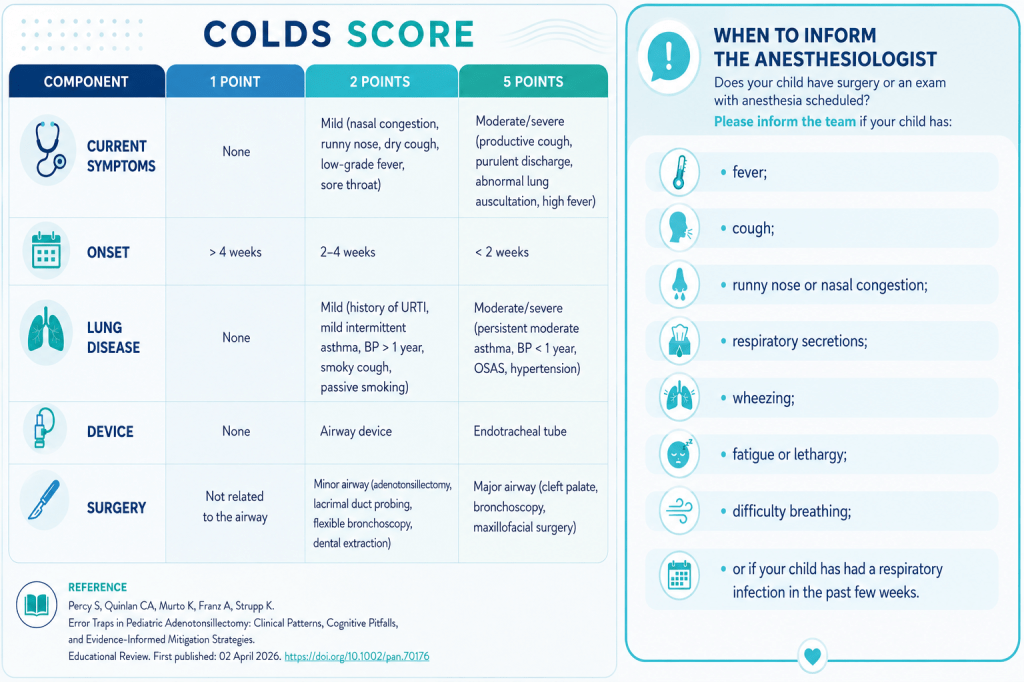
Children with a current or recent respiratory infection have a higher risk of respiratory events during anesthesia, such as laryngospasm, bronchospasm, desaturation, apnea, and the need for respiratory support.
This is where the COLDS score can be useful. It is a tool that helps the anesthesiologist organize some of the main factors associated with this risk.
The acronym COLDS stands for:
- C — Current symptoms: the presence and severity of active symptoms;
- O — Onset: when the symptoms began;
- L — Lung disease: the presence of lung disease, such as asthma;
- D — Device: the type of airway device that will be used;
- S — Surgery: the type of surgery, especially when it involves the airway itself.
The higher the score, the greater the potential risk of respiratory events.
Importantly, the COLDS score is not a “traffic light” that determines on its own whether surgery should go ahead or be cancelled.
There is no single number that automatically requires the anesthesiologist to cancel a procedure. The decision depends on the combination of factors related to the child, the procedure, and the respiratory illness.
But why can a simple cold affect anesthesia?
During a respiratory infection, the airways become inflamed and more reactive.
Imagine the bronchi and the area around the larynx becoming more “sensitive” than usual. During anesthesia, this increased irritability can lead to exaggerated responses to airway manipulation and secretions.
This can result in complications such as laryngospasm, when the vocal cords involuntarily snap shut, or bronchospasm, when the bronchi constrict.
There is another important factor: anesthesia reduces some of the natural mechanisms that help keep the airway open and protect the lungs. Depending on the procedure, devices may be needed to assist or control breathing.
That is why a child who is “just a little congested” may have a much more reactive airway during anesthesia than they would under normal circumstances.
What if this happens?
The anesthesiologist is precisely the professional trained to recognize and treat these situations.
During anesthesia, the child is continuously monitored, and the team remains prepared to intervene if respiratory problems arise. There are specific strategies and medications available to treat bronchospasm, laryngospasm, and other complications.
But there is a very important principle in medicine:
It is better to prevent a complication, whenever possible, than to treat one after it occurs.
That is why, when surgery is elective, it may make sense to wait until the child has recovered.
So, can a child with a cold never have anesthesia?
A mild runny nose does not automatically mean that surgery will be cancelled.
On the other hand, symptoms such as fever, significant lethargy, a severe cough, abundant respiratory secretions, wheezing, or signs of airway involvement may weigh heavily in the decision to postpone an elective procedure.
Other factors are also taken into consideration, including the child’s age, previous respiratory conditions, prematurity, exposure to smoke, the type of surgery, and how the airway will need to be managed.
And there are situations in which surgery simply cannot wait.
For example, emergency surgery may need to be performed even when a child has a respiratory infection. In that situation, the team assesses the risks and adapts the anesthetic plan to make the procedure as safe as possible.
The same reasoning applies to some procedures that are specifically intended to improve a child’s breathing, such as certain ear, nose, and throat surgeries. The risks of waiting must also be considered.
What about imaging exams?
This question comes up quite often as well.
CT scans and, especially, MRI exams may require a child to remain completely still throughout the procedure. In young children, this often means using sedation or anesthesia.
Therefore, the fact that it is “just an exam” does not mean that anesthetic risk disappears.
If the exam is elective and can safely be postponed, it may be safer to perform it once the child has recovered. If it is urgent, however, the benefit of performing the exam may outweigh the increased anesthetic risk.
How long should we wait?
This is one of the most difficult questions to answer with a single number.
Respiratory risk is higher during an active infection and in the first few weeks afterward. As time passes, airway hyperreactivity tends to decrease.
For this reason, in selected cases, an interval of at least 1 to 2 weeks after symptoms have resolved may be considered, while more significant respiratory illnesses may justify a longer delay. In some children—especially when other risk factors are present—the anesthesiologist may recommend waiting even longer.
In other words, it is not simply:
“It has been two weeks since the cold, so we’re good to go.”
The appropriate timing depends on both the child and the procedure.
What if the surgery cannot wait?
When a procedure is necessary and a child has recently had a respiratory infection, there are strategies that can help reduce anesthetic risk.
The team may, for example, carefully choose the airway management technique, use medications when appropriate, and adapt the anesthetic plan to the child’s respiratory condition.
The goal is not to expect the risk to be zero—this practically never exists in medicine—but rather to determine whether the benefit of performing the procedure at that particular time outweighs the additional risk.
How can I get better information?
During the pre-anesthesia consultation.
Tell the anesthesiologist everything you can: when the symptoms started, whether there was fever, cough, or increased secretions, whether the child had wheezing, which medications were used, whether medical care was needed, and when your child returned to their usual state.
Even a cold that seems to have “already gone away” is important information.
Don’t be frustrated if the procedure is postponed!
When the anesthesiologist recommends waiting a few more days or weeks, it does not mean that anesthesia is dangerous or that something is necessarily wrong with your child.
It means that, at that particular moment, waiting may be the safer choice.
Because when we talk about pediatric anesthesia, safety also means knowing when it is better not to take off just yet.


Deixe um comentário